Concrete Foundations & Footings
The structural support your building needs to stay solid and level for decades.
Why Your Foundation Matters Most
Your foundation is literally what everything else sits on. A properly built foundation keeps your structure level, prevents settling and cracking, and protects against moisture damage. Cut corners on the foundation and you will spend years dealing with problems like uneven floors, stuck doors, wall cracks, and water intrusion. Get it right from the start and your building will stand solid for generations.
We pour concrete foundations and footings for room additions, garages, sheds, covered patios, retaining walls, and new construction throughout Mission Viejo. Whether you are building something new or replacing a failed foundation, we use engineering standards and proper techniques to ensure your structure has the solid support it needs. This is not the place to take shortcuts or hire the cheapest contractor you can find.
Understanding Foundations and Footings
A footing is the wider base that sits below the foundation wall. It spreads the weight of the structure over a larger area of soil so the building does not sink or settle unevenly. Footings need to be poured below the frost line and on undisturbed or properly compacted soil. The foundation wall then sits on top of the footing and supports the structure above.
In Southern California, we deal with different soil types and seismic requirements that affect foundation design. Some areas have expansive clay soil that swells when wet and shrinks when dry. Other locations have sandy soil that settles easily. We test your soil conditions, follow local building codes, and engineer the foundation to handle your specific site conditions and the weight of your structure.
Types of Foundations We Install
The right foundation type depends on your building, soil conditions, and budget. We install several common foundation types in residential and light commercial projects:
- •Slab on grade: A single pour that combines footing and floor in one piece, common for garages and additions
- •Stem wall foundations: Footings with vertical walls that create a crawl space, typical for house additions
- •Post and pier foundations: Individual concrete piers that support beams, often used for decks and elevated structures
- •Grade beam foundations: Connected beams that tie pier foundations together for added strength
- •Monolithic slabs: One continuous pour that forms footing and floor simultaneously
Each type has advantages depending on your project. A slab on grade costs less and works well for simple structures. Stem walls allow access to plumbing and utilities underneath. Post and pier foundations work on slopes and uneven terrain. We will explain which option makes sense for your building and site conditions.
The Foundation Installation Process
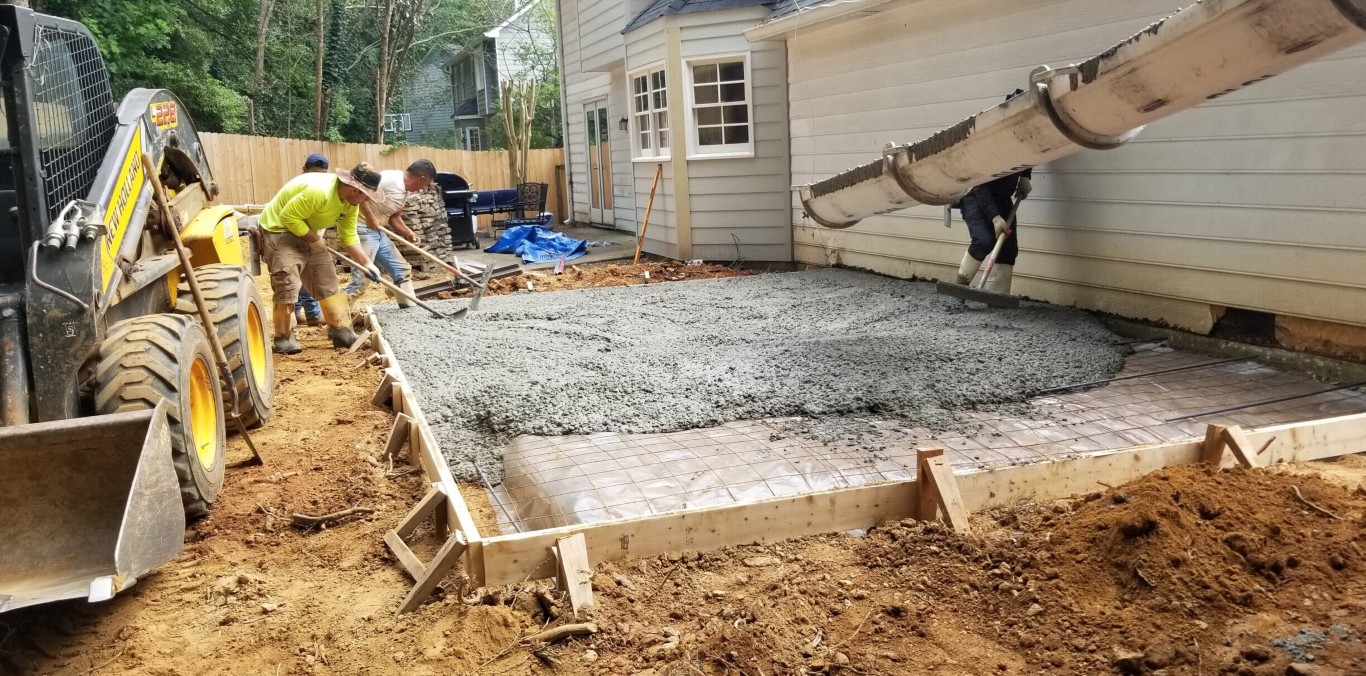
Foundation work starts with site preparation and excavation. We dig trenches for footings to the depth required by code and your soil conditions. The trenches need clean, level bottoms on undisturbed soil. If we encounter soft or unstable soil, we excavate deeper and replace it with compacted fill.
Next comes forming, rebar installation, and inspection. Forms hold the concrete in place while it cures. Rebar provides tensile strength that plain concrete lacks. Most foundations require inspection by building officials before we can pour. Once approved, we pour the concrete, ensure proper consolidation to eliminate voids, and finish the top surface level and smooth.
Why Proper Foundations Cost More
Foundation work involves excavation, precise forming, heavy rebar, inspections, and quality concrete. It takes time and costs more than surface flatwork. But this is the worst place to cut costs. A failed foundation can make your entire structure unsafe and cost tens of thousands to repair. Doing it right the first time is always cheaper than fixing it later.
We follow engineering standards, use proper materials, and get all required inspections. Your foundation will be built to code and engineered for your specific site and structure. You get documentation, permits, and the peace of mind that comes from knowing your building has solid support underneath. Ready to start your foundation project? Learn about our approach and standards, or explore related services like concrete slabs and retaining walls.
Need Foundation Work?
Contact us for a site assessment and detailed engineering quote for your foundation project.
(949) 998-2713